
Hannover Messe 2026 and the History of the Industrial Fair
From the 1947 export fair to industrial AI: a sourced look at the latest completed edition and the history behind it.
עברית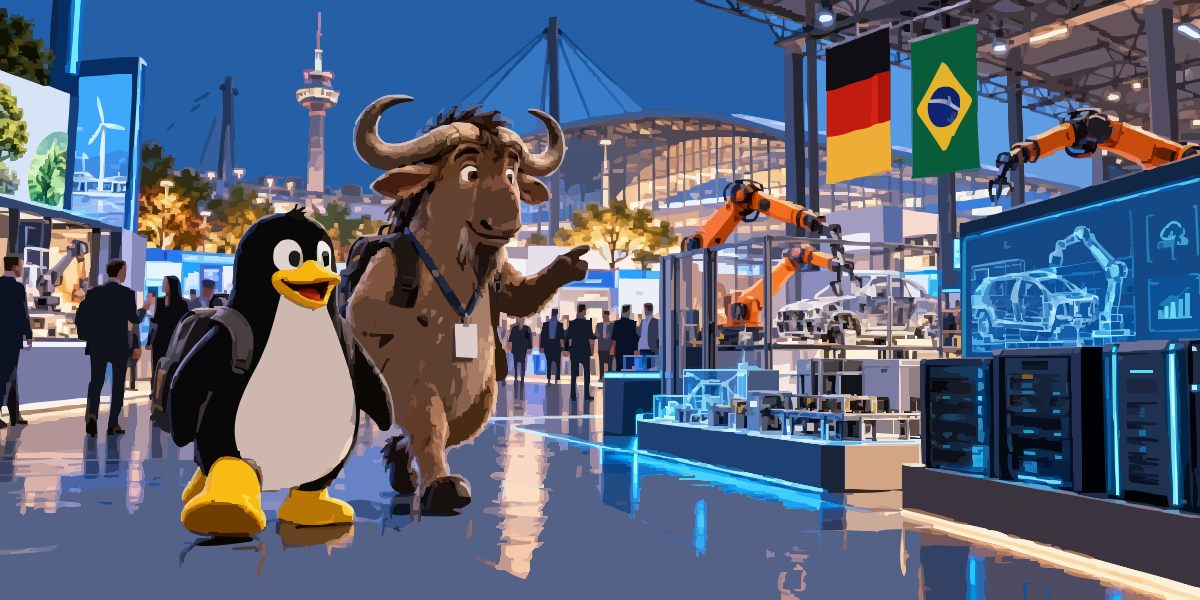
The latest completed edition: April 2026
The most recent completed Hannover Messe was held from 20 to 24 April 2026, with Brazil as partner country. The organizer’s closing report put attendance at approximately 110,000. Its overview emphasized industrial AI, automation, robotics and energy infrastructure. These are the organizer’s reported themes and figures, rather than a claim that every demonstration was already ready for deployment.
AUMA’s event database records 2,835 exhibitors and 108,898 visitor entries for the 2026 edition. This more specific statistical presentation should be identified as such rather than silently substituted for a rounded press-release figure. For readers comparing events across years, a consistent definition and source are more useful than an apparently precise number without context.
Sources: Deutsche Messe — 2026 closing report · AUMA — 2026 event statistics
From a technology display to an operating system for a factory
The interesting question for a Linux administrator is what stands behind a convincing industrial demonstration. A robot, a sensor gateway and a monitoring dashboard may depend on different networks, operating systems and maintenance schedules. The visible application is only one part of the service. Identity, time synchronization, reliable storage and software distribution can determine whether the same demonstration survives ordinary production conditions.
An exhibition is a good place to ask the questions that product slogans leave open. Can the system keep working when its internet connection disappears? How are security updates tested and delivered? Which information can be exported, and in which format? What happens when the manufacturer stops supporting a particular device? These questions do not diminish innovation; they connect a new idea to the work required to operate it.
A concrete open-source connection: industrial data spaces
Fraunhofer IESE’s 2026 exhibition programme described digital twins, Asset Administration Shells and controlled industrial data exchange. It also identified Eclipse BaSyx as open-source middleware for this area. The programme illustrates how industrial digitalization includes shared descriptions and software interfaces, alongside machines and factory equipment.
For a small operator, this is a useful connection to the open-source world. A machine-readable description can help different components agree on what a value means. An open implementation can make integration easier to inspect. Neither one removes the need to manage permissions, understand the data model or keep the deployed software maintained. The operational value appears when the interface and its behavior are clear enough for another team to use.
Sources: Fraunhofer IESE — 2026 exhibition programme
1947: the export fair and economic reconstruction
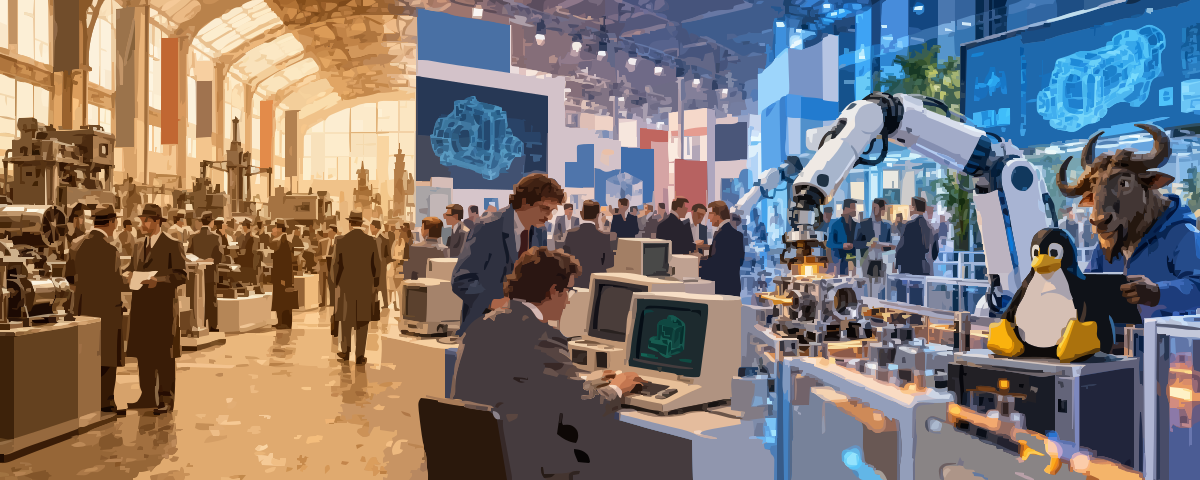
The Lower Saxony State Archives dates the first export fair’s opening to 18 August 1947. It was assembled at former light-metal works in Laatzen under the postwar British administration’s initiative. The event belonged to an effort to restart economic activity and reconnect manufacturers with buyers beyond Germany.
That origin matters when interpreting today’s industrial fair. It began with the practical problem of reconnecting production, trade and confidence after a catastrophic war. The history is not simply a sequence of larger halls. It is also a history of the institutions, transport and international relationships that make an exhibition possible. A factory display only becomes a trade fair when people can reach it and understand what can actually be supplied.
Sources: Lower Saxony State Archives — the first fair in 1947
Milestones: industry, computing and the exhibition grounds
According to Deutsche Messe’s historical outline, foreign exhibitors joined the German Industrial Fair in 1950; the Hannover Messe name was adopted in 1961. CeBIT became a separate event in 1986. The exhibition grounds were subsequently transformed in preparation for Expo 2000.
The city’s history explains the computing connection: office and information technology received its own Hall 1 in 1970, and CeBIT eventually separated as the field expanded. Its last edition took place in 2018. Hannover Messe and CeBIT are therefore related chapters, but they should not be treated as two names for the same event.
This distinction helps explain why computers and communications are so closely associated with Hannover. Information technology grew into a major exhibition subject in its own right. Today, industrial software often appears inside a wider manufacturing process: a computer vision system, a digital production record or a model linked to a physical machine. The context has changed, even when some of the underlying computing tasks remain recognizable.
Sources: Deutsche Messe — historical timeline (PDF) · Hannover city — trade fair and CeBIT history
Reading the AI story with an administrator’s eye
An AI demonstration should be assessed through its inputs, decisions and failure behavior. Ask which data the system uses, where those data are processed and how an incorrect output is detected. For a real installation, somebody needs to know when to stop automation, how to investigate a result and how to return to a known working state.
This is an editorial perspective for readers of the TUX blog, not a finding that every exhibitor implements the same safeguards. A model that works well on an exhibition sample may still need validation against a particular factory’s conditions. A useful purchasing discussion should identify the boundary between a prototype, a supported product and a claim about a future capability.
What to bring home from a trade fair
The most useful result may be a better set of questions. Keep notes about interfaces, support arrangements, export formats and the people who can answer a technical follow-up. Ask for documentation that can be reviewed after the presentation. A working example and a small trial with agreed success criteria are easier to evaluate than a broad promise of transformation.
For an independent hosting or Linux project, the connection to industry lies in familiar responsibilities: keep systems understandable, preserve access to data and make recovery possible. Hannover Messe’s history shows how the subjects on display evolve. The task for the operator is to turn a promising technology into a service whose behavior can be explained and maintained.